



Published on June 20, 2026
What do we mean when we talk about resilience, especially for civil society spaces?
Very traditionally, organisational resilience has been understood through the lens of economic viability. However, for civil society organisations, this question is more nuanced and is getting complicated by the day.
As non-profits and civil society organisations work towards eliminating a particular problem, one can argue that, in a very utopian sense, they work to abolish themselves when the issue has been resolved, or they find a new purpose. However, in the current world order where inequality, discrimination, hate, and violence are being used to divide societies, people, movements, as well as govern access to resources, opportunities and infrastructures, the civic space finds itself at a juncture where ‘accepting consequences’ and ‘being resilient’ become highly appreciated virtues, as organisations and individuals are having to shift priorities even when it comes to defining what a ‘purpose’ itself should look like.
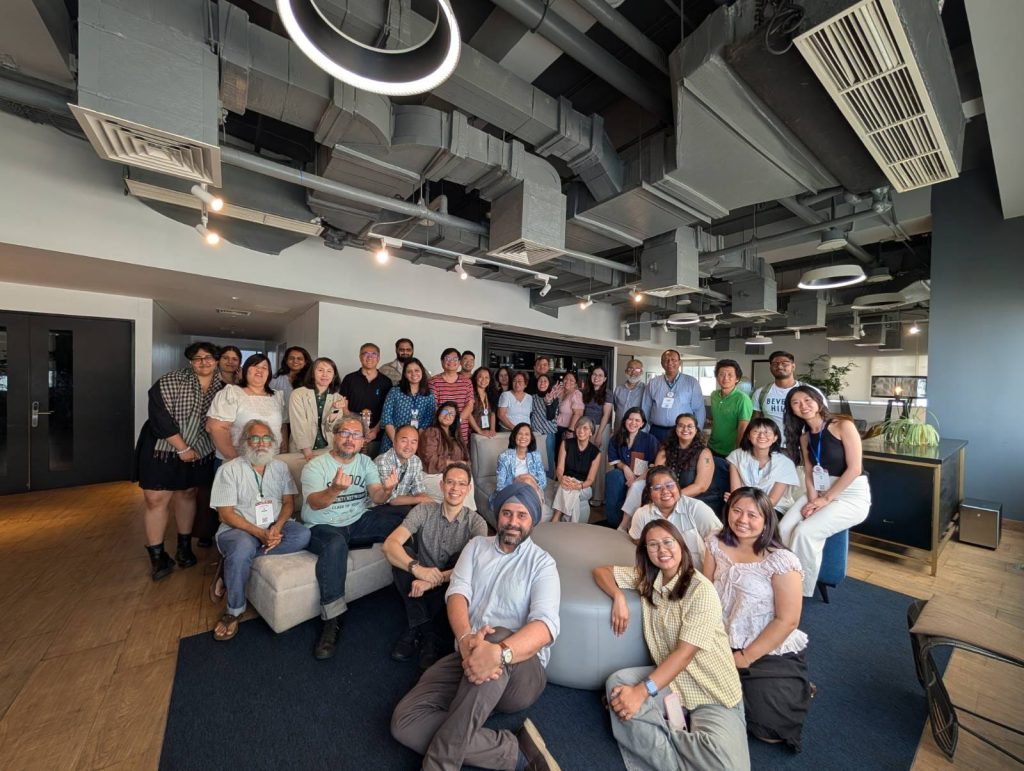
To reflect on these difficult questions as well as strategies to navigate such ecosystems, a safe, trusted and shared infrastructure was co-created by some of the civil society organisations in Southeast Asia in the year 2023 in Chiang Mai. This shared infrastructure was designed as an inclusive and welcoming physical space to build connections, collaborations, and solutions to tackle the existing challenges present in the region from the lens of digital rights; hence, the name became Digital Rights Asia-Pacific Assembly.
This year, DRAPAC was organised in Manila, Philippines, and the theme of the assembly was “Resilient Digital Futures: Co-creating Collective Resources across Movements”. It was co-hosted by EngageMedia, The Foundation for Media Alternatives, and DAKILA Philippine Collective for Modern Heroism with support from the Association for Progressive Communications, Oxfam, Porticus, Sweden Sverige and Luminate.
This blog will mostly outline and engage with some of the opening plenary discussions that happened and why they matter or should matter to all of us.
The discussion began with reflections on resilience in international development and social movements, especially reflecting on post-tsunami recovery efforts that were carried out in South and Southeast Asia to over decades of movements towards open source, access to information and digital rights. Resilience was one of the most celebrated ways of ‘being’ in civil society. Yet we find ourselves in a position where resilience is often synonymous with endurance, with civil society being expected to absorb shrinking funding, increasing workloads, tech threats, political repression and most importantly, emotional exhaustion. For some, these factors lead to moral exhaustion, while others continue to do more with less, sacrificing well-being, family time, and personal financial security in the pursuit of social change. What is more surprising is that, in many cultures, such suffering is treated as an expected part of work, with ‘consequences’ being closely tied to the language of resilience. Low salaries, burnout, harassment, violence, and even threats to one’s life are often framed as inevitable consequences of fighting for justice. There is a price to pay for passion, one of my friends, who is a journalist, said once.
While resilience is indeed an important human characteristic and capacity, it becomes
concerning when it is elevated into the primary response to injustice. As in such cases, resilience shifts attention away from the structural causes of suffering and places responsibility on individuals and communities to adapt. In some cases, the question becomes ‘how do we adapt ourselves and become stronger in tolerating it’ rather than ‘how do we eliminate the problem?’ An example of this could be artificial intelligence, as despite growing evidence that AI systems are leading to discrimination, being used as tools against marginalised communities and harming the environment, public discussions are increasingly more towards the argument of how one can adapt and/or whether certain applications should exist at all. Many digital security trainers also, on a day-to-day basis, train activists and civil society organisations how to protect themselves from gender based violence, harassment and surveillance, which again focuses on individuals surviving hostile digital environments rather than challenging the power structures that enable such abuse in the first place. It also becomes dangerous when resilience produces internalised acceptance of oppression. Many victims, mostly women, are forced to defend their identities and reputations by having to prove that fabricated images are not real when someone creates an AI-generated deepfake pornography using their identity. After platforms take their sweet time to remove such content, victims find themselves answering questions such as are you sure it’s not real?” or “Did you share intimate images before?” by police, lawyers and platform moderators. In different cultural contexts, it can also lead to offline harassment, honour-based crimes, or even death.
Most importantly, resilience is not evenly distributed; not everyone has the same capacity to absorb shocks and recover due to differences in social support, access to resources, differences in wealth and geography, as well as prior experiences of oppression. However, the networks perpetuating the harms are highly resilient, for example, the disinformation networks, as they are supported by economic and political incentives to design and distribute misleading information and entire infrastructures exist to sustain it. Therefore, certain resilience techniques are deliberately cultivated.
In response, one of the speakers during the assembly called for narrative resilience, which civil society actors need, to withstand harmful narratives as they continue to promote truth, democratic values, principles, and inclusive visions of society. For example, while fighting against disinformation requires stronger platform accountability, fact-checking, and literacy initiatives, at the same time, it also requires independent journalism, adequate infrastructural support, fair compensation, and opportunities for rest for civil society actors. The challenge is not simply to ‘endure’, and it should certainly not become an excuse for governments, corporations, or institutions to evade responsibility.
Drapac is also a space, which leaves you with not just ‘food for thought’ but also some examples and ways one can materialise their ideas. I am going to leave you with a few such conversations. One of the first sessions I attended was on creativity and humour; the curators talked about merging investigative research, quick wit and storytelling to communicate complex and critical issues even as traditional media and civic spaces shrink, and also the ethical challenges one may encounter along the way. It was curated by Zachary Borromeo, Pitik Bulag / DAKILA, Elvin Jay Macanlalay, DAKILA, Jascyl Jee Sayson, Pitik Bulag, and Archill Niña Capistrano, UP Cebu / Children’s Legal Bureau.
Another session, inspired by the idea of ‘it takes a village to raise a child’, was on identifying support needed by participants present in the room, such as advice, safety support, or opportunities, as well as what they can offer to others, such as experience, skills, or connections, therefore facilitating existing but scattered forms of support within the community. It was led by Zahra Aliya, DigitallyTante, Aindriya Barua, Shhor AI and Subinoy Eron of Activate Rights.
The panel I moderated, as a representative of Digital Empowerment Foundation, also presented a documentary sharing visual evidence of AI data centres coming to India, showing responses from communities and experts on how incentives and resources are being distributed and how it is actually the communities who stand to pay most of the price of such a development. It also shared citizen awareness toolkits to understand the environmental impacts of AI and what questions one may ask if such a development happens in their neighbourhoods. The speakers included Mavic Conde, BicoldotPH, Pavitra Ramanujam, Association for Progressive Communications (APC) and Osama Manzar, Founder-Director, Digital Empowerment Foundation.
Written by Maitri Singh
Digital Empowerment Foundation